

|
Job Discussion Forums
"The Internet's Meeting Place for ESL/EFL Students and Teachers from Around the World!"
|
| View previous topic :: View next topic |
| Author |
Message |
jotham
Joined: 05 Jul 2007
Posts: 77
|
 Posted: Tue Aug 21, 2007 2:18 am Post subject: Posted: Tue Aug 21, 2007 2:18 am Post subject: |
 |
|
| Kilgore Trout wrote: |
Analyzing English Grammar, Second Edition, Thomas P. Klammer and Muriel Shultz (would you like the rest?)
"Coordinators join grammatical structures of similar form, transforming them into a single grammatical unit. They join words . . . When single words or phrases are joined, the result is a phrase. When two sentences are joined by coordinating conjunctions, the result is a compound sentence". (Need a page number?) |
I agree with this statement, but I don't think it forbids us from using initial coordinators. It doesn't say "Coordinators necessarily join grammatical structures of similar form." Rather I infer it to mean "Coordinators primarily or generally join grammatical structures of similar form."
| Quote: |
| and it goes against academic convention. |
I see a lot of people agreeing with this, but I'm not willing to concede even on this point, which was the one I was asking for a reference on.
Last edited by jotham on Tue Aug 21, 2007 2:40 am; edited 1 time in total |
|
| Back to top |
|
 |
Kilgore Trout
Joined: 18 Jul 2007
Posts: 27
Location: Japan
|
| Posted: Tue Aug 21, 2007 2:25 am Post subject: |
|
|
| G Cthulhu wrote: |
| Kilgore Trout wrote: |
Finally, I have a Linguistics professor as a student and will ask him for his academically based opinion and post the answer here after I find out. |
Never got around to any Wittgenstein when you were busy doing your two degrees, did you?   |
Do you mean his famous "Explanations come to an end somewhere" ?
I had a single course in Philosophical Semantics that covered him briefly but not enough to be well-versed by any means.
Aside from that, not enough apparently.
You know how you can get to tracking in one direction in this discipline. |
|
| Back to top |
|
|
Kilgore Trout
Joined: 18 Jul 2007
Posts: 27
Location: Japan
|
| Posted: Tue Aug 21, 2007 2:41 am Post subject: |
|
|
| jotham wrote: |
| Kilgore Trout wrote: |
Analyzing English Grammar, Second Edition, Thomas P. Klammer and Muriel Shultz (would you like the rest?)
"Coordinators join grammatical structures of similar form, transforming them into a single grammatical unit. They join words . . . When single words or phrases are joined, the result is a phrase. When two sentences are joined by coordinating conjunctions, the result is a compound sentence". (Need a page number?) |
I agree with this statement, but I don't think it forbids us from using initial coordinators. It doesn't say "Coordinators necessarily join grammatical structures of similar form." Rather I infer it to mean "Coordinators primarily or generally join grammatical structures of similar form."
| Quote: |
| and it goes against academic convention. |
I see a lot of people agreeing with this, but I'm not even willing to concede on this point, which was the one I was asking for a reference on. |
Personally, and only personally, I try to rely on the idea that a person using coordinators to begin sentences has a lazy approach to writing. It is, in effect, another dumbing down of the language for the benefit of those who appear to be rhetorically challenged. A simple perusal of a reference book, probing of the memory or consultation of MS WORD's thesaurus would be ample enough effort to produce the necessary term to avoid a controversial usage.
Another strong opinion I hold is that this phenomena simply furthers the poor writing seen coming out of schools today. Of course, people have been making similar remarks for some time in the latter 20th century to present, but I am certain they are well deserved based on my former teaching of composition as well as the trash I read on the Internet.
Thus, if you truly believe that this usage is completely acceptable, you would only have to prove your point by supplying some credible evidence to support your unwillingness to concede that the usage of coordinator at the beginning of a sentence does not smack of a conversational tone.
I think teaching this method to people who do not know the language well enough to use it correctly may be part of the problem and none of the solution. |
|
| Back to top |
|
|
jotham
Joined: 05 Jul 2007
Posts: 77
|
| Posted: Tue Aug 21, 2007 3:12 am Post subject: |
|
|
| Kilgore Trout wrote: |
| Another strong opinion I hold is that this phenomena simply furthers the poor writing seen coming out of schools today. Of course, people have been making similar remarks for some time in the latter 20th century to present, but I am certain they are well deserved based on my former teaching of composition as well as the trash I read on the Internet. |
I definitely can agree with you here on the quality of writing in general. But I don't think I would blame initial coordinators for poor writing skills � I rather blame poor writing skills for awkward initial coordinators. Another way to put it: just because poor writers use commas awry doesn't mean that commas are bad.
| Quote: |
| Thus, if you truly believe that this usage is completely acceptable, you would only have to prove your point by supplying some credible evidence to support your unwillingness to concede that the usage of coordinator at the beginning of a sentence does not smack of a conversational tone. |
Conversational can be a subjective factor that's hard to pin down. And much academic writing is jargon-filled and icy to be sure � but is that preferable or even desirable? Perhaps there's a British-American difference here: Americans prefer clear, direct, comfortable, and facilitated reading of texts, even in technical writing. Indeed, criticism abounds of murkiness when reading IRS tax forms, for example. Perhaps the "conversational" quality that initial conjunctions seem to lend in this area could help.
| Quote: |
| I think teaching this method to people who do not know the language well enough to use it correctly may be part of the problem and none of the solution. |
The OP asked an open-ended question � but I suppose it was for purposes of teaching English. Still, if I were teaching English, I would be careful with my words. I might encourage students to connect choppy sentences and show them how; but I would never do so by telling them that initial coordinators are entirely uncouth and an unmitigated error. |
|
| Back to top |
|
|
Kilgore Trout
Joined: 18 Jul 2007
Posts: 27
Location: Japan
|
| Posted: Tue Aug 21, 2007 3:00 pm Post subject: |
|
|
I suppose the tone of my post must appear to be that harsh, and I apologize for that.
However, I have found that teaching writing to groups of 18 and 19 year olds generally calls for some very direct instruction, particularly when they are writing in a second language. I truly think that a 16 week class hardly provides the forum for this to be accomplished in most cases. Thus, the pass/fail standard suffers immensely and even a C provides enough incentive for some to boast of success. The writings and the classes are never very difficult, so the standard has to be, or there is nothing to provide incentive.
Unfortunately, I do not subscribe to much more with these students than a rather rigid discipline to reinforce fundamental skills through repetition, proofreading and self editing. I hope at least to ingrain some sense of responsibility in their writing approach if nothing else.
I take this approach for several reasons, but the most important is that many of them have little or no writing skill and even less motivation.
I certainly do not blame them, but I find that at some point in their academic careers they will need these skills to perform, and of course, they will need to hone those skills to utilize them in their work.
I guess what I am trying to say is that I would rather make sure they can write functionally (though this may not be a strong issue either way) and I only hope to get through to a relatively small percentage, but I always hold out hope for a larger number.
Conversational was probably a poor choice of words and jargon may actually be more accurate. However, I would point out that the state of academic writing today may be at its worst at anytime in recent history and certainly is neither prefrable nor desirable for me any longer. I have taught alongside many wannabes with various eclectic approaches to basic writing, but I rarely see any of them do what I do, which is roll up my sleeves and roll around in the mess to help these people make some sense of what they are attempting to compose. When I do come up for air, I see that many students, at least, appreciate the effort and that helps motivate me to attemptmore clarity in explanation.
From the amount of Linguisitcs Journal articles I have read over the past year, I woudl definitely say that their are definite differences in American and British styles. Of course, we are talking the pinnacle of writing in that regard, and it may not be a fair comparison.
Though we are straying a bit from the point here, I always pride myself in modeling these methods for students and certainly try not to insult them.
Uncouth and unmitigated certainly are not terms I would ever choose when speaking to a group of non-native writers in a composition course because I am fairly sure that 99% would never understand (and this is not meant to poke fun or be petty).
In the end, the issue clearly is one of much debate and has found no further resolution here.
A former Generative Transformational Grammar professor applied the only technique I can remember to be effective in deciding unclear rules of grammar. He had the class vote with only two choices available and remarked, "Well, that settles it, at least in this class, today". |
|
| Back to top |
|
|
Henry_Cowell

Joined: 27 May 2005
Posts: 3352
Location: Berkeley
|
| Posted: Tue Aug 21, 2007 3:32 pm Post subject: |
|
|
There is a widespread belief -- one with no historical or grammatical foundation -- that it is an error to begin a sentence with a conjunction such as and, but, or so. In fact, a substantial percentage (often as many as 10 percent) of the sentences in first-rate writing begin with conjunctions. It has been so for centuries, and even the most conservative grammarians have followed this practice. Charles Allen Lloyd's 1938 words fairly sum up the situation as it stands even today:
"Next to the groundless notion that it is incorrect to end an English sentence with a preposition, perhaps the most wide-spread of the many false beliefs about the use of our language is the equally groundless notion that it is incorrect to begin one with 'but' or 'and.' As in the case of the superstition about the prepositional ending, no textbook supports it, but apparently about half of our teachers of English go out of their way to handicap their pupils by inculcating it. One cannot help wondering whether those who teach such a monstrous doctrine ever read any English themselves."
---Chicago Manual of Style [the premier style and usage reference for academic writing and publishing in the United States] |
|
| Back to top |
|
|
jotham
Joined: 05 Jul 2007
Posts: 77
|
| Posted: Tue Aug 21, 2007 3:36 pm Post subject: |
|
|
| Quote: |
| In the end, the issue clearly is one of much debate and has found no further resolution here. |
Well, a resolution isn't necessary. Few people change their minds on the spot; but civil discourse may induce certain individuals to reflect on things for weeks or months before a change of mind takes place. As for me, I had never heard anyone in academia say this, so my curiosity was piqued.
I seem to be getting a mixed bag from your responses. You say you're a linguist; yet you almost talk like a grammarian. You mentioned about generative grammar � are you a generativist linguist? That might explain a little: I tend to lean towards that philosophy (though I'm not a linguist); it's usually the functionalists that I and grammarians butt heads with.
Last edited by jotham on Tue Aug 21, 2007 3:43 pm; edited 3 times in total |
|
| Back to top |
|
|
Henry_Cowell
Joined: 27 May 2005
Posts: 3352
Location: Berkeley
|
| Posted: Tue Aug 21, 2007 3:37 pm Post subject: |
|
|
There is a well-known prescription prohibiting the use of coordinators at the beginning of a sentence. Nevertheless, coordination often occurs in this position. Sentence-initial or turn-initial coordination is most common at the beginning of a turn in conversation.... However, it is also relatively common in writing....
Longman Student Grammar of Spoken and Written English |
|
| Back to top |
|
|
JonnyB61

Joined: 30 Oct 2006
Posts: 216
Location: Japan
|
| Posted: Tue Aug 21, 2007 3:39 pm Post subject: |
|
|
And now for something completely different.
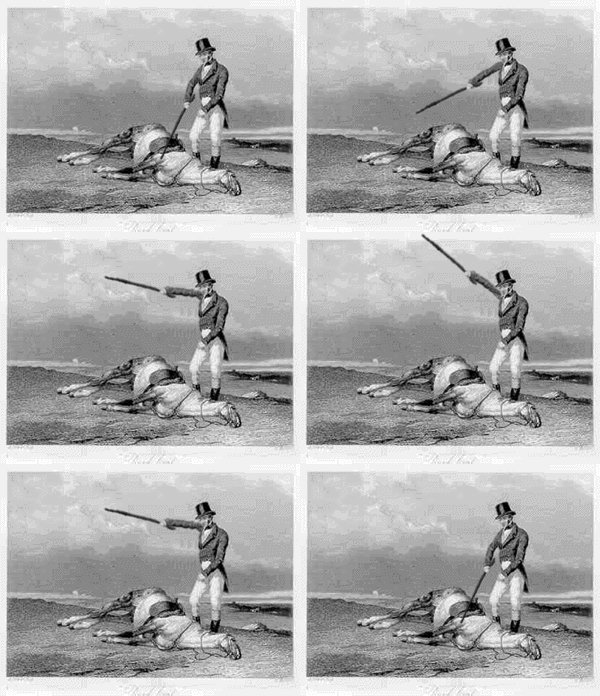
A man flogging a dead horse.
 |
|
| Back to top |
|
|
jotham
Joined: 05 Jul 2007
Posts: 77
|
| Posted: Tue Aug 21, 2007 3:40 pm Post subject: |
|
|
| Henry_Cowell wrote: |
There is a well-known prescription prohibiting the use of coordinators at the beginning of a sentence.
Longman Student Grammar of Spoken and Written English |
There may be a "prescription," but it doesn't come from prescriptivists: they criticize it vehemently. |
|
| Back to top |
|
|
Henry_Cowell
Joined: 27 May 2005
Posts: 3352
Location: Berkeley
|
| Posted: Tue Aug 21, 2007 4:00 pm Post subject: |
|
|
| JonnyB61 wrote: |
And now for something completely different.
A man flogging a dead horse. |
This particular dead horse (starting sentences with coordinating conjunctions) pops up all too frequently on Dave's. It never seems to die.  |
|
| Back to top |
|
|
|
|
You cannot post new topics in this forum
You cannot reply to topics in this forum
You cannot edit your posts in this forum
You cannot delete your posts in this forum
You cannot vote in polls in this forum
|
This page is maintained by the one and only Dave Sperling.
Contact Dave's ESL Cafe
Copyright © 2018 Dave Sperling. All Rights Reserved.
Powered by phpBB © 2001, 2002 phpBB Group
|


 FAQ
FAQ Search
 Memberlist
 Usergroups
 Register
 Profile
 Log in to check your private messages
 Log in


