

|
Korean Job Discussion Forums
"The Internet's Meeting Place for ESL/EFL Teachers from Around the World!"
|
| View previous topic :: View next topic |
| Author |
Message |
Demophobe

Joined: 17 May 2004
|
 Posted: Tue Feb 13, 2007 1:32 am Post subject: Posted: Tue Feb 13, 2007 1:32 am Post subject: |
 |
|
I guess I don't post enough here.
I have no affinity aside from what I consider to be revolutionary. I am not a tech evolutionist; ramping things (core speeds, memory clocks) up doesn't really do much for me, and this has been the current state of CPUs for a long, long time. (+/-)
Penryn is exciting, so I'm into it. Plain and simple. I am no fanboy; if AMD were to make the announcements first - thus indicating that they weren't a johnny-come-lately - I would lauding them instead.
I have an ATI card in my ancient system now and I tell ya, it's a champ. I like ATI more than Nvidia from a sentimental (?) point of view, but Nvidia have again FABed a revolution.
I like companies that push the envelope and take chances.
And Wrench, I too am counting my green. I have a three-year old system that looks like it's going to be around for a while to come.
Take care guys and we'll see where we are when the dust settles. |
|
| Back to top |
|
 |
Wrench
Joined: 07 Apr 2005
|
| Posted: Tue Feb 13, 2007 3:23 am Post subject: |
|
|
| I agree with you demo.. AMD does push the envelope as well. The only major difference AMD had a long term goal when they designed Hypertransport and the K8. Their implementation of Dual and quad cores is more elegant the intells. I personnaly want to see the new platform (No more Bus)from intel more then I want to see their shrinked c2d's. |
|
| Back to top |
|
|
gsxr750r

Joined: 29 Jan 2007
|
| Posted: Tue Feb 13, 2007 3:38 am Post subject: |
|
|
I want to see higher CPU speeds more than I do more cores.
I'd rather have 2 cores running smoothly (and cool) at 4.0ghz than 4 cores running at 2.4ghz, and no software to take advantage of it.
I bet Demo would agree with me on that. |
|
| Back to top |
|
|
cubanlord

Joined: 08 Jul 2005
Location: In Japan!
|
| Posted: Tue Feb 13, 2007 3:44 am Post subject: |
|
|
| gsxr750r wrote: |
I want to see higher CPU speeds more than I do more cores.
I'd rather have 2 cores running smoothly (and cool) at 4.0ghz than 4 cores running at 2.4ghz, and no software to take advantage of it.
I bet Demo would agree with me on that. |

You'll only be able to notice a difference when video editing. Games are not made today where the average semi decent CPU cant handle the demand required from the games. My wife's PC (my old one) has a 940 intel 3ghz cpu and it can handle F.E.A.R. just fine (with the 6800GT in there). Avg. = 45 fps. Now, my current pc is avg. 96 fps, but, then again, my current one is a beast. Still, the avg. person does not need the power that some of the processors put out.
And, with the true dual cores and the quads out now...well....there is nothing on the market, currently, or in the near future that will truly test the quad cores ability (minus servers and EXTREME....EXTREME video editors out there 'few and far in between too').
Last edited by cubanlord on Tue Feb 13, 2007 4:19 am; edited 1 time in total |
|
| Back to top |
|
|
gsxr750r
Joined: 29 Jan 2007
|
| Posted: Tue Feb 13, 2007 4:08 am Post subject: |
|
|
That's the thing, though.... software.
According to what I read, it's a horrid hell for software developers to write games for multiple cores.
Maybe they just need to hone their ways. |
|
| Back to top |
|
|
Wrench
Joined: 07 Apr 2005
|
| Posted: Tue Feb 13, 2007 4:31 am Post subject: |
|
|
| gsxr750r wrote: |
That's the thing, though.... software.
According to what I read, it's a horrid hell for software developers to write games for multiple cores.
Maybe they just need to hone their ways. |
Its not that hard. Its just software developers are lazy creatures. Companies thow stuff out the doors before they are even ready. There were SMP games since q3. |
|
| Back to top |
|
|
Demophobe
Joined: 17 May 2004
|
| Posted: Tue Feb 13, 2007 1:54 pm Post subject: |
|
|
| gsxr750r wrote: |
I want to see higher CPU speeds more than I do more cores.
I'd rather have 2 cores running smoothly (and cool) at 4.0ghz than 4 cores running at 2.4ghz, and no software to take advantage of it.
I bet Demo would agree with me on that. |
Darn right....and a number of professionals agree that advancements in single-core technology is desirable over a multi-core situation from a number of standpoints. Why did they abandon single core work, that is a good question, but easy to answer. I guess that it was all about money. New substrates, FABs, dealing with heat and power concerns; this all equated to Intel and AMD taking the easiest route for keeping up with Moore's law (actually, they aren't, if you think about it) and keeping CPUs in their upward (instead of lateral - feature-rich) direction.
That said, if we must go multi-core, then the more the merrier. Intel are hoping that in the short term, their tying cores together (not a true "quad-core" in the purist sense) will make for a more productive environment. I am not sure if it's harder to code for a true 4 core CPU or for two dual cores (behaving as would 2 single CPUs), but it's my understanding that with the few methods to deal with multi-core coding, the more CPUs that are thrown onto the mix, the more difficult it becomes.
Intel went with hyper-threading, virtualizing one CPU, and we really didn't see the fruits of that in a lot of software as it faded away quickly into the shadows of multi-core. Multi-core first came to the public eye (at least for me) with the "cell" processor, first discussed in consoles. This eclipsed hyper-threading and devs set their sights on true multi-cores, not virtualization.
Well, HT is coming back in Penryn. If it can be taken advantage of, it will mean 4 true core and 4 virtual cores. Not sure what that means in the real world, to be honest. Not yet, anyways. But people...look at Penryn (and of course, AMDs doing the same?) Low-K, Hafnium insulation, metal switching gates, 45nm...it's a beaut! If it were running at 4+GHz as a single-core solution, now that would be big-time innovation.
Bottom lne here is that we are in a multi-core environment and there is nothing we can do. It's a tough thing for people to filter the ideas and products being thrown at them these days. Two cores, four cores, hyper-threaded quad core...what does it all mean? Well, we hope it means a faster, more efficient computing environement, but truthfully, I think the obfuscation is becoming unbearable. Things may be moving too fast for the average bear, and this may come back to bite Intel and AMD in the end.
If people begin to see a lot of jargon and spin on products, they become wary and may actually do some reading before buying. Intel and AMD better hope that the software world (the common big suites of programs - Office, Adobe, etc) can make use of a multi-core environment, and people had better be able to clearly feel and see an improvement, or, I hope, they will be a bit miffed. Suckered.
I guess that takes me almost full circle here; a single core solution is more desirable. Intel have some great innovation in Penryn, but factually, each core is slower than it's P4 predecessor. We give them that room on accepting a multi-core solution. It's nice for them; it's hard to keep advancing in a single-core design; far more difficult than what they are into now. And it seems to me that we will never be able to go back now. Penryn has a lot of features. It's a shame that there is such a crazy focus on clock speeds as selling points than on features. SSE2, Hyper-transport, Hyper-threading; these are are lateral innovation; they are instruction sets for CPUs and this is a direction I wish they would have gone. Look at how much these features helped in applications!
Rambling....gotta go.
Interesting stuff. |
|
| Back to top |
|
|
Wrench
Joined: 07 Apr 2005
|
| Posted: Tue Feb 13, 2007 8:18 pm Post subject: |
|
|
Sorry to burst your bubble Demo
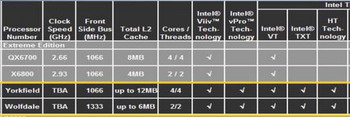
In the course of studying fresh road-map Intel, in which are already prescribed the 45 NM processors yorkfield and Wolfdale, which relate to generation penryn, some sources began to speak about the revival of technology hyper-Threading. To us the idea the introduction of hyper-Threading support to four core processor multi-chip layout seemed to be not entirely reasonable.
Yesterday associate came out with the confirmation of information about the support of processors penryn to technology hyper-Threading. Associates stated that this technology actually can return, but only at the end of 2008, when will appear 45 NM processors with architecture nehalem. Let us recall that they will be made from the monolithic four core crystal in one of their modifications appear the core (Bloomfield) and the support Of hyper-Threading in this case actually can go for the benefit.
Later on the pages of one popular forum appeared slide from official road map Intel, dated by past week. It actually contained the references about the support Of hyper-Threading by processors yorkfield and Wolfdale:
However, the close to Intel sources indicated that this picture contains error, and processors penryn will not support hyper-Threading technology .
 |
|
| Back to top |
|
|
gsxr750r
Joined: 29 Jan 2007
|
| Posted: Tue Feb 13, 2007 9:43 pm Post subject: |
|
|
Well, my notebook is dual-core (Intel) and I often wonder if AMD dual-core would have been faster from a Ram usage perspective. I know that Intel wins all of the specs, but I also see my Intel Coreduo trudging along at points that I feel might be due to less efficient memory usage between cores.
I'm really curious about this topic. |
|
| Back to top |
|
|
Wrench
Joined: 07 Apr 2005
|
| Posted: Tue Feb 13, 2007 10:10 pm Post subject: |
|
|
The Turion laptops aren't great either.. THey have high points but they are not that spectacular.. I think S1 Turion are ok as far as memory bandwidth but if your talking about the CoreDuo you got TUrion licked..
Unless AMD decided to implement NUMA in a notebook  That be sweet That be sweet |
|
| Back to top |
|
|
Demophobe
Joined: 17 May 2004
|
| Posted: Wed Feb 14, 2007 3:14 am Post subject: |
|
|
| Wrench wrote: |
However, the close to Intel sources indicated that this picture contains error, and processors penryn will not support hyper-Threading technology .
|
Yeah...posting rumors...serves me right.
 |
|
| Back to top |
|
|
Wrench
Joined: 07 Apr 2005
|
| Posted: Wed Feb 14, 2007 4:20 am Post subject: |
|
|
| Demophobe wrote: |
| Wrench wrote: |
However, the close to Intel sources indicated that this picture contains error, and processors penryn will not support hyper-Threading technology .
|
Yeah...posting rumors...serves me right.
|
Hehe..
Hyperthreading was and is a mistake.. Its just a piss poor solution that really wastes a lot of good resources.. It was a stop gap against AMD and thats all. But because so many apps have the HT optimizations lots of dual core CPU's actually have the HT flags in them so instead of virtualizing it on one cpu die it spreads it across two cpu's.. Its still a half assed effort at creating multithreaded apps but its better then nothing. |
|
| Back to top |
|
|
Demophobe
Joined: 17 May 2004
|
| Posted: Wed Feb 14, 2007 2:24 pm Post subject: |
|
|
| Wrench wrote: |
Hehe..
Hyperthreading was and is a mistake.. Its just a piss poor solution that really wastes a lot of good resources.. It was a stop gap against AMD and thats all. But because so many apps have the HT optimizations lots of dual core CPU's actually have the HT flags in them so instead of virtualizing it on one cpu die it spreads it across two cpu's.. Its still a half assed effort at creating multithreaded apps but its better then nothing. |
There was also a compensatory aspect of HT as well, what with the P4 Northwoods having such a long pipeline. How to keep it full? Virtual threads and accurate branch prediction.
From 30 to 14 stages with the C2D (thus the low clock speeds for C2D) and a 97% success rate for direct and 75% for indirect branches makes the C2D quite efficient in branch prediction, something that was also sorely necessary for the P4's long pipeline to be full. This too was made up for it it's ability to scale up in speed. Funny how that worked for them...remember the GHz race?
As a sidenote, it's interesting to see that although the GHz race is over, we are now seeing some lateral moves, ie; feature implementation, something I thought was needed in a single-core environment. But who would buy a CPU that is slower (clock) than the one they have? Can you imagine? A 2.2GHz CPU outperforming a 3.4GHz? Someone at Intel would hang.
So, a long pipe needs more instructions to be full (efficient) and a good branch prediction (the penalty for incorrectness was too high). The pipeline made the CPU scale up well, but that was necessary because of itself; longer = greater penalty for wrong prediction. So, more clocks and virtual threads came in to save the day.
Although I don't think it was a total waste of time (HT, that is), I agree it came to strike back at AMD. But then, what's new? |
|
| Back to top |
|
|
|
|
You cannot post new topics in this forum
You cannot reply to topics in this forum
You cannot edit your posts in this forum
You cannot delete your posts in this forum
You cannot vote in polls in this forum
|
|


 FAQ
FAQ Search
 Memberlist
 Usergroups
 Register
 Profile
 Log in to check your private messages
 Log in


