

|
Korean Job Discussion Forums
"The Internet's Meeting Place for ESL/EFL Teachers from Around the World!"
|
| View previous topic :: View next topic |
| Author |
Message |
laogaiguk

Joined: 06 Dec 2005
Location: somewhere in Korea
|
 Posted: Fri Jul 14, 2006 2:17 pm Post subject: Posted: Fri Jul 14, 2006 2:17 pm Post subject: |
 |
|
| Ya-ta Boy wrote: |
| I've always wondered what is so darn unique about the turtle ship. The Romans had metal-plated ships. |
I meant the turtle formation. They would use their shields to create a wall around themselves on all sides and up, and leave little slits to poked some form of sharp weapon through, usually a spear. The Romans had such well trained soldiers that many people would just run when they saw them in action. |
|
| Back to top |
|
 |
bluelake
Joined: 01 Dec 2005
|
| Posted: Fri Jul 14, 2006 4:22 pm Post subject: |
|
|
| Zulu wrote: |
| Newbie wrote: |
A couple of years ago I visisted the grave of some Korean dude that apparently invented the pulley system... When was this great feat accomplished, ca. 1780!!!  |
Now the Koreans claim they even invented the pulley? You have to get used to this stuff living here. But wasn't there that old Greek fella, oh, you know, nobody important, Archimedes http://www.answers.com/topic/archimedes who did that about 205 BC?
You have to distinguish between what Koreans like to say they've accomplished, and what they actually have. |
People are probably referring to Chŏng Yak-yong (Tasan), an 18th C. Silhak (practical learning) scholar. He did not invent the pulley system; he learned about it in China and came up with a crane for erecting the walls at Suwon Fortress. The Silhak scholars were not inventors, per se, but innovators; they were looking for practical applications of ideas, not the "thinking for the sake of thinking" that most neo-Confucian literati practiced. It's interesting to note that Tasan was one of the first Korean Catholic converts; Christianity was another idea brought to Korea, through China, that the Silhak scholars found interesting. |
|
| Back to top |
|
|
doggyji

Joined: 21 Feb 2006
Location: Toronto - Hamilton - Vineland - St. Catherines
|
| Posted: Fri Jul 14, 2006 6:11 pm Post subject: |
|
|
| Bingo wrote: |
3. Anti-Western (and expecially anti-US) sentiment is a luxury Koreans cannot afford.
4. Koreans act like all of these benefits (from Western contact) just fell from the sky. |
Okay, it's not even worth mentioning that Koreans use lots of stuff first invented in western countries. So Koreans are not entitled to criticize any of the great western nations where all the goods have come from? Koreans just have to keep their mouths shut, smile and cheer for the west no matter what happens? What's your view on the French? They are part of "the west" and yet lots of stuff they use have come from, say, the US. Would you say the same thing? Is it a luxury for them to have protests against the US administration at times? Or they are OK unlike Korea because they as part of the west have contributed in other things? What about Belgium, Iceland, Ireland, or even Canada?
| Zulu wrote: |
Now the Koreans claim they even invented the pulley? You have to get used to this stuff living here. But wasn't there that old Greek fella, oh, you know, nobody important, Archimedes http://www.answers.com/topic/archimedes who did that about 205 BC?
You have to distinguish between what Koreans like to say they've accomplished, and what they actually have. |
I learned Chung Yak-yong made(or maybe invented depending on the definition of the word) 거중기(guh choong ki) which is a kind of a crane that uses the pulley system, not the pulleys. I never heard a single Korean saying pulleys were first invented in Korea.
| djsmnc wrote: |
I think if I were Korean, I would say something more along the lines of "What do you think of our food? It's not so rich, and contains a lot of vegetables, so it tends to keep people rather healthy"
rather than
"Kimchi is Korea national food. Kimchi is spicy than the other food and foreigner can not eat spicy food well"
or
"Did you know that Korea has a stronger steel industry these days? The Hyndai company is becoming well known these days for creating strong ships"
rather than
"Korea is number one for ships. Many country military wants Korea ship"
|
Here is one thing. When you don't speak the language well, you tend to make sentences as simple as possible, needless to mention that you make lots of bad word choices. Sometimes you would just use the words that you are familiar with even if you don't feel those are the most suitable. Sometimes you would feel like using the words that were not very often used so far just to try out. Sometimes you would make up a bit of BS just to explain it within your proficiency. If you have learned a difficult second language and tried to converse a lot(or exclusively) using it, you might know what I mean. It feels like you have suddenly become a toddler or a kindergartner. Statements become pretty obtuse. So if the other person's all ready and happy to nitpick and accuse you of something rather than trying to filter and catch the true meaning of what is said, then it's all his/her easy game. |
|
| Back to top |
|
|
eamo

Joined: 08 Mar 2003
Location: Shepherd's Bush, 1964.
|
| Posted: Fri Jul 14, 2006 7:36 pm Post subject: |
|
|
| Quote: |
| Here is one thing. When you don't speak the language well, you tend to make sentences as simple as possible, needless to mention that you make lots of bad word choices. Sometimes you would just use the words that you are familiar with even if you don't feel those are the most suitable. Sometimes you would feel like using the words that were not very often used so far just to try out. Sometimes you would make up a bit of BS just to explain it within your proficiency. If you have learned a difficult second language and tried to converse a lot(or exclusively) using it, you might know what I mean. It feels like you have suddenly become a toddler or a kindergartner. Statements become pretty obtuse. So if the other person's all ready and happy to nitpick and accuse you of something rather than trying to filter and catch the true meaning of what is said, then it's all his/her easy game. |
If you're referring to Djsmnc's Korean food nationalism post then you are being to generous to Koreans.
They really believe they have come up with the most awesome food in the world. Food that can prevent SARS and AIDS. To the extent that one Korean 'inventor' made a kimchi-filter air-con which will ward off any diseases in the house where its used. |
|
| Back to top |
|
|
doggyji
Joined: 21 Feb 2006
Location: Toronto - Hamilton - Vineland - St. Catherines
|
| Posted: Fri Jul 14, 2006 7:47 pm Post subject: |
|
|
| eamo wrote: |
| Quote: |
| Here is one thing. When you don't speak the language well, you tend to make sentences as simple as possible, needless to mention that you make lots of bad word choices. Sometimes you would just use the words that you are familiar with even if you don't feel those are the most suitable. Sometimes you would feel like using the words that were not very often used so far just to try out. Sometimes you would make up a bit of BS just to explain it within your proficiency. If you have learned a difficult second language and tried to converse a lot(or exclusively) using it, you might know what I mean. It feels like you have suddenly become a toddler or a kindergartner. Statements become pretty obtuse. So if the other person's all ready and happy to nitpick and accuse you of something rather than trying to filter and catch the true meaning of what is said, then it's all his/her easy game. |
If you're referring to Djsmnc's Korean food nationalism post then you are being to generous to Koreans.
They really believe they have come up with the most awesome food in the world. Food that can prevent SARS and AIDS. To the extent that one Korean 'inventor' made a kimchi-filter air-con which will ward off any diseases in the house where its used. |
Okay, I know there are some real dummies. Can't deny that. What I'm doing is just suggesting other possibilities. Who knows.  |
|
| Back to top |
|
|
eamo
Joined: 08 Mar 2003
Location: Shepherd's Bush, 1964.
|
| Posted: Fri Jul 14, 2006 7:54 pm Post subject: |
|
|
| doggyji wrote: |
| eamo wrote: |
| Quote: |
| Here is one thing. When you don't speak the language well, you tend to make sentences as simple as possible, needless to mention that you make lots of bad word choices. Sometimes you would just use the words that you are familiar with even if you don't feel those are the most suitable. Sometimes you would feel like using the words that were not very often used so far just to try out. Sometimes you would make up a bit of BS just to explain it within your proficiency. If you have learned a difficult second language and tried to converse a lot(or exclusively) using it, you might know what I mean. It feels like you have suddenly become a toddler or a kindergartner. Statements become pretty obtuse. So if the other person's all ready and happy to nitpick and accuse you of something rather than trying to filter and catch the true meaning of what is said, then it's all his/her easy game. |
If you're referring to Djsmnc's Korean food nationalism post then you are being to generous to Koreans.
They really believe they have come up with the most awesome food in the world. Food that can prevent SARS and AIDS. To the extent that one Korean 'inventor' made a kimchi-filter air-con which will ward off any diseases in the house where its used. |
Okay, I know there are some real dummies. Can't deny that. What I'm doing is just suggesting other possibilities. Who knows. |
Some real dummies?
I guess quite a large portion of Korean people believe kimchi has preventative powers. Not just a few cranks. It's a common belief here.
Next time you have a dinner with Koreans where there's a lot of traditional dishes, start asking about the health benefits of each dish. Everything is good for something!! 'This is good for the blood'. 'That is good for 'stamina'! 'This is good for the liver'.....and so on.
They are intensely proud of their food and often make ridiculous claims about it's health benefits. This will include doctors, newspapers and TV news. Not just a few cranks. |
|
| Back to top |
|
|
Ya-ta Boy
Joined: 16 Jan 2003
Location: Established in 1994
|
| Posted: Fri Jul 14, 2006 8:10 pm Post subject: |
|
|
| Quote: |
| I meant the turtle formation. |
I know, but I was asking about the ship. |
|
| Back to top |
|
|
mithridates

Joined: 03 Mar 2003
Location: President's office, Korean Space Agency
|
| Posted: Fri Jul 14, 2006 8:26 pm Post subject: |
|
|
 |
|
| Back to top |
|
|
Guri Guy

Joined: 07 Sep 2003
Location: Bamboo Island
|
| Posted: Fri Jul 14, 2006 8:27 pm Post subject: |
|
|
Regarding Kim-chi, it is pickled cabbage that has the excellent health properties. Saurkraut (spelling?) actually has the same benefits and potentially none of the negatives. (Such as high sodium and Stomach Cancer rates)
Here is the nutritional information about Japanese pickled cabbage. There were no results when I searched for Kim-Chi. 
Excellent website by the way if you are concerned about nutrition.
http://www.nutritiondata.com/facts-B00001-01c21z1.html |
|
| Back to top |
|
|
Guri Guy
Joined: 07 Sep 2003
Location: Bamboo Island
|
| Posted: Fri Jul 14, 2006 8:43 pm Post subject: |
|
|
| Quote: |
Hangul is the only alphabet in
the whole world invented by man.
It is a purely phonetic alphabet with 10 vowels and 14 constants.
"The computer, which we think of as all-powerful, is driven by the repetition of
two numbers--0 and 1-according to certain rules, but it has propelled
the world into the information age almost instantaneously.
It is the same with music.
In Western music, seven notes--do, re, mi, fa, sol, la, ti-are used to create
innumerable scores from the classical works of Mozart
to the rap songs of Seo Taiji that Korean adolescents love.
The same is true with Hangul.
It is a characteristic of Hangul that the limited code of 24 letters,
sfter several rules are applied, creates an unlimited number of sounds.
In this way, Hangul is more scientific than any other writing system, and it is based
on the same principles as the computer, a product of modern science." |
http://library.thinkquest.org/20746/non/info/index.html
Even if this is true and I find it highly debatable that one man invented Hangul, it is incorrect. It is much more likely that a group of scholars invented Hangul. Still a big accomplishment in my opinion. However, George Guess invented an alphabet for his people the Cherokee. By himself. Koreans must be sore from patting themselves on the back sometimes. There are other people in the world... 
Interesting reading anyway about the origins of Hangul. Very cool website.
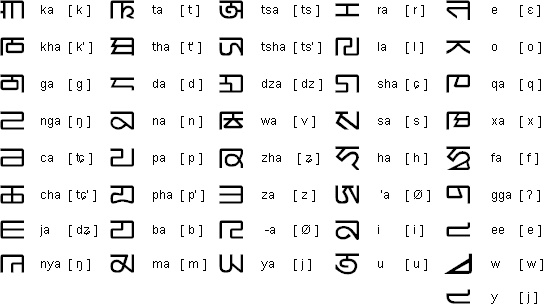
King Sejong and his scholars probably based some of the letter shapes of the Korean alphabet on other scripts such as Mongolian and 'Phags Pa, and the traditional direction of writing (vertically from right to left) most likely came from Chinese, as did the practice of writing syllables in blocks.
Even after the invention of the Korean alphabet, most Koreans who could write continued to write either in Classical Chinese or in Korean using the Gukyeol or Idu systems. The Korean alphabet was associated with people of low status, i.e. women, children and the uneducated. During the 19th and 20th centuries a mixed writing system combining Chinese characters (Hanja) and Hangeul became increasingly popular. Since 1945 however, the importance of Chinese characters in Korean writing has diminished significantly.
Here is the Phagspa "alphabet". I see some definite simularities.
Here is Mongolian.
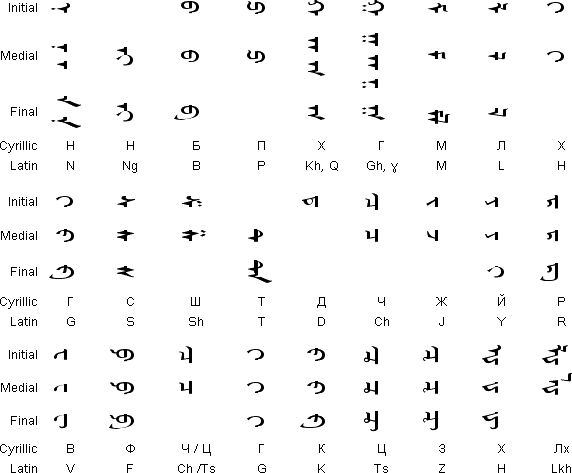
http://www.omniglot.com/writing/korean.htm |
|
| Back to top |
|
|
bluelake
Joined: 01 Dec 2005
|
| Posted: Fri Jul 14, 2006 9:09 pm Post subject: |
|
|
| Guri Guy wrote: |
| Quote: |
Hangul is the only alphabet in
the whole world invented by man.
It is a purely phonetic alphabet with 10 vowels and 14 constants.
"The computer, which we think of as all-powerful, is driven by the repetition of
two numbers--0 and 1-according to certain rules, but it has propelled
the world into the information age almost instantaneously.
It is the same with music.
In Western music, seven notes--do, re, mi, fa, sol, la, ti-are used to create
innumerable scores from the classical works of Mozart
to the rap songs of Seo Taiji that Korean adolescents love.
The same is true with Hangul.
It is a characteristic of Hangul that the limited code of 24 letters,
sfter several rules are applied, creates an unlimited number of sounds.
In this way, Hangul is more scientific than any other writing system, and it is based
on the same principles as the computer, a product of modern science." |
http://library.thinkquest.org/20746/non/info/index.html
Even if this is true and I find it highly debatable that one man invented Hangul, it is incorrect. It is much more likely that a group of scholars invented Hangul. Still a big accomplishment in my opinion. However, George Guess invented an alphabet for his people the Cherokee. By himself. Koreans must be sore from patting themselves on the back sometimes. There are other people in the world... |
It was a group of scholars. They were commissioned by Sejong. |
|
| Back to top |
|
|
pocketfluff

Joined: 30 May 2006
Location: Washington, DC (school) and Los Angeles, CA (home)
|
| Posted: Fri Jul 14, 2006 10:20 pm Post subject: |
|
|
| Quote: |
| To the extent that one Korean 'inventor' made a kimchi-filter air-con which will ward off any diseases in the house where its used. |
But does it make your home smell like buttstankin' kimchi 24/7?  |
|
| Back to top |
|
|
Zulu
Joined: 28 Apr 2006
|
| Posted: Fri Jul 14, 2006 10:31 pm Post subject: |
|
|
| doggyji wrote: |
Okay, it's not even worth mentioning that Koreans use lots of stuff first invented in western countries. So Koreans are not entitled to criticize any of the great western nations where all the goods have come from? Koreans just have to keep their mouths shut, smile and cheer for the west no matter what happens? |
Not at all. I probably criticize my own government more than most Korean people. I hate Bush and his illegal, immoral war in Iraq. The US, like China, Russia, England, France and other countries has a lot to learn about foreign and domestic policy. But it really pisses me when I see Koreans spit on soldiers here. These people saved Korea a longtime ago. You should show them a little respect even if you hate their leader. Some of them really hate Bush, too. In France many hate Bush. Fine. But most French people are still grateful for what the US, Britain, Canada and other allies did there during the war. In the Netherlands if they find out you're a Canuck, they'll likely buy you a beer for the same reason. What happens if in Korea you say you were a Korean War vet? The majority of young people simply don't care or worse, some will insult you.
So let's get one thing straight. I'm not talking about the right to protest the US or any other country. What bugs me is that so often the Korean media, and a lot of Korean people, like to pretend that the economy is doing well because of 'Korean dynamism' and an inherant racial superiority, Korea's being 'better-educated' their 'superior manual dexterity from use of chopsticks', or whatever.
| doggyji wrote: |
| What's your view on the French? They are part of "the west" and yet lots of stuff they use have come from, say, the US. Would you say the same thing? Is it a luxury for them to have protests against the US administration at times? Or they are OK unlike Korea because they as part of the west have contributed in other things? |
I love France and many French things. They've invented a lot of things as well and have made many great scientific and artistic contributions to the world. That said, no, of course I don't agree with everything France has done either. Nuclear testing on South Pacific islands? Not cool. Blowing up New Zealand shipping? Not cool. Trying to sell advanced European weapons to China these days? Not cool. They have a legit beef with the Bush administration but that's politics. There are racists in France too, like Le Pen, but the xenophobia there deosn't seem as widespread as here.
| doggyji wrote: |
| What about Belgium, Iceland, Ireland, or even Canada? |
Belgium I have problems with politically. Until Hitler came on the scene Leopold 2 was probably the worst despot to hit Europe, just ask the Congolese. They still have trouble admitting this and prefer to glorify that bastard.
Iceland. No problem. Ireland, great neutral country with wonderful beer, some of the world's best music and a keen sense of wit and humor. Canada has had it's moments in the past but have done a lot to make up for this - Nunavut being a prime example. It's certainly one of the most progressive nations on Earth and would be in my top 5 places to live. I've lived there and can say it's extremely cosmopolitan and laid back. In many ways I prefer it to the states and envy them as they don't have to endure Bush directly. Oh, and they have a better hockey team! Grrrr. They've also made many scientific contributions and have some world class universities. Yeah, I like all those places you've mentioned not beause of their obvious scientific and tech contributions but because the cultures are just more open to the rest of the world.
| doggyji wrote: |
| Here is one thing. When you don't speak the language well, you tend to make sentences as simple as possible, needless to mention that you make lots of bad word choices. Sometimes you would just use the words that you are familiar with even if you don't feel those are the most suitable. Sometimes you would feel like using the words that were not very often used so far just to try out. Sometimes you would make up a bit of BS just to explain it within your proficiency. If you have learned a difficult second language and tried to converse a lot(or exclusively) using it, you might know what I mean. It feels like you have suddenly become a toddler or a kindergartner. Statements become pretty obtuse. So if the other person's all ready and happy to nitpick and accuse you of something rather than trying to filter and catch the true meaning of what is said, then it's all his/her easy game. |
That's cool Doggyji and I respect you for learning the language. If you lose some of the meaning on this board that's cool, no problem. I think only a total idiot would make fun of you for that. But when we're talking about the Korean English language (or even Korean language) media this is no excuse, nor should it be. They know exactly what message they wish to convey and do so regulary in the Korea Herald, Times and Arirang TV. |
|
| Back to top |
|
|
Zulu
Joined: 28 Apr 2006
|
| Posted: Sat Jul 15, 2006 2:50 am Post subject: |
|
|
| mithridates wrote: |
|
1) Han-gul? Developing an alphabet of exactly 25 characters is pretty specific and nothing of great significance. Loads of civilizations developed alphabets and writing systems millennia before Saejong hit the scene.
2) Moveable type. Prior to both Gutenburg or the Koreans, wasn't it the Chinese dude, Pi Sheng, during the Ch'ing-li period (1041-1048) who actually invented moveable type? Regardless, there were printing mechanisms in the Middle East and probably even Europe long before that.
Writing, books, and printing. The first known use of symbols used for communication dates back about 1.2 million years and was discovered in Europe (Bulgaria). There are numerous other known early examples of recording human thought including those at the French Caves of Lascaux (30,000 years ago) to sea-shell scratchings in Neolithic China (8000 years ago). More finds are being unearthed all the time all over the world.
But in more �recent� times the Sumerians developed the first real writing systems and the Egyptian civilization had the first widespread use of writing on papyrus, even before Chinese paper was invented. The first known inventions for printing communicative symbols were Mesopotamian cylinder seals, used in modern day Iraq around 3500 BC. There is also some speculation that the ancient Greeks may have used a printing wheel thousands of years ago and a fragment of one has been found. Like most ancient printing this art was likely rare and lost to the Dark Ages long before the invention of moveable type. The Chinese started writing on paper around 105 AD and began printing around 200 AD.
The world�s oldest book is Etruscan, and was discovered in modern-day Europe (again, in Bulgaria). It�s six-pages in length and composed of gold pages; made about 2,500 years ago, it's much older than even Ireland�s beautiful Book of Kells, China�s Diamond Sutra or any early Korean Buddhist text.
3) Iron-clad warships. Perhaps, but then again they invented neither iron, nor warships either. The ancient Greeks used iron on warships (especially in battering rams) thousands of years before the turtle ships so it's not much to go on about.
4) Gunpowder, mortars and bombs? Again sounds like the Koreans probably got these, like so many other things before Western contact, from China or maybe even Japan.
5) The first suspension bridges were Korean, too?! Hmm, let's see. Bridges were in use all over the world in pre-historical times. Some of the vine variety could certainly qualify as suspension bridges but we simply don�t know where they first appeared as they no longer exist. But the earliest known scientifically engineered ones (arch bridges) appeared in Mesopotamia in about the 6th century BC. The greatest bridge builders of ancient times are generally thought to have been the Romans. The first suspension bridge in historical times was a chain link example in China (not Korea), in about 206 BC during the Han Dynasty. That'd be about 1,800 years before your Korean claim of �world�s first� 1592 AD, don�t you think?
I still vote for metal chopsticks as the best Korean invention of all time. |
|
| Back to top |
|
|
Zulu
Joined: 28 Apr 2006
|
| Posted: Sat Jul 15, 2006 2:56 am Post subject: |
|
|
| captain kirk wrote: |
| Korea was a vassal state of China and got its know how mostly from there. China was making iron a thousand years before anyone, anywhere else. It got the high temps necessary to smelt iron from their pottery kiln technology which was way ahead, just slipped the iron in there and voila, whadyaknow? China was organized, a civilization with government, beaurocracy, high populations, large cities. Europe has, in comparison, been a backwater and didn't have its moments in the sun in terms of being a civilization until after the Middle Ages. How can one take history personally and attempt to refute it? Supposedly your Western Heiney is larger than the Asian variety. Take pride in that! |
Do I detect a little hatred of all things Western my man? Uh, Greece anyone? Rome anyone? The Celts?
By the way the Anatolians, Egyptians and Mesopotamians had been smelting iron since around 3000 BC - around 2500 hundred years later, circa 500 BC, the Chinese became one of many civilizations to then add to iron-making refinements.
From a Korean website: �Hangul is the only alphabet in the whole world invented by man.� �Hangul is more scientific than any other writing system�
Amusing. So thousands of years before the Koreans got Hangul, when they were probably living in the forests, the Phoenicians, Mesopotamians, Harappans, Romans, Greeks, Hebrews, Chinese, and all the other ancient civilizations had their women do all the inventing of alphabets? Well, I guess those civilizations were even further ahead of their times than I thought. And they had no consonant or vowel sounds either? Funny, that�s not how I remember it from my from my Latin class. And in modern times alphabets from Inuktitut to IPA were not invented by man? Well, thank God for Area 51 and alien technology. �Hangul is more scientific than any language�. Shrug. Yet another ultra-nationalist myth bites the dust. |
|
| Back to top |
|
|
|
|
You cannot post new topics in this forum
You cannot reply to topics in this forum
You cannot edit your posts in this forum
You cannot delete your posts in this forum
You cannot vote in polls in this forum
|
|


 FAQ
FAQ Search
 Memberlist
 Usergroups
 Register
 Profile
 Log in to check your private messages
 Log in


