

|
Korean Job Discussion Forums
"The Internet's Meeting Place for ESL/EFL Teachers from Around the World!"
|
| View previous topic :: View next topic |
| Are you (practically speaking) Atheist? |
| Yes. |
|
53% |
[ 51 ] |
| No. |
|
46% |
[ 44 ] |
|
| Total Votes : 95 |
|
| Author |
Message |
gang ah jee

Joined: 14 Jan 2003
Location: city of paper
|
 Posted: Sun Nov 05, 2006 1:56 pm Post subject: Posted: Sun Nov 05, 2006 1:56 pm Post subject: |
 |
|
| A very minor point Satori, but I think when Rteacher says materialism he means non-theistic philosophies, whereas when you say materialism I get the feeling that you're meaning motivations based on the accumulation of material wealth. Would that be about right? |
|
| Back to top |
|
 |
flotsam
Joined: 28 Mar 2006
|
| Posted: Sun Nov 05, 2006 2:01 pm Post subject: |
|
|
| That's pretty revolutionary gaj, posts like that will save days of scrolling... |
|
| Back to top |
|
|
Satori
Joined: 09 Dec 2005
Location: Above it all
|
| Posted: Sun Nov 05, 2006 3:20 pm Post subject: |
|
|
| gang ah jee wrote: |
| A very minor point Satori, but I think when Rteacher says materialism he means non-theistic philosophies, whereas when you say materialism I get the feeling that you're meaning motivations based on the accumulation of material wealth. Would that be about right? |
Yeah. Clash of theoretical frameworks. I'm happy to use the mainstream meaning. |
|
| Back to top |
|
|
Troll_Bait

Joined: 04 Jan 2006
Location: [T]eaching experience doesn't matter much. -Lee Young-chan (pictured)
|
| Posted: Mon Nov 06, 2006 2:53 am Post subject: |
|
|
| Rteacher wrote: |
My understanding is that although the current age tends to get increasingly degraded there will be an extended period of peace and harmony for the next 10,000 years (although another world war might be necessary first if the general level of spiritual conciousness doesn't improve dramatically...)
But after that relatively brief period, things will progressively deteriorate in all respects...
Srimad-Bhagavatam 9:16:33 Purport
"The next avatar incarnation is Kalki. That is yet to take place. Kalki avatara will appear at the end of this age, Kali- yuga. The age of Kali-yuga, duration of this age is still to be, I mean to say, fulfilled in 400,000's of years. So at the end of Kali, that means at the last stage, after about 400,000's of years, the incarnation of Kali will appear. That is predicted in the Vedic literatures, as Lord Buddha's appearance was also predicted in the Srimad-Bhagavatam. And Srimad-Bhagavatam was compiled five thousand years ago, and Lord Buddha appeared about 2,500 years ago. Therefore about Lord Buddha's appearance it is predicted that at the beginning of Kali-yuga Lord Buddha will appear. There was prediction, and that has actually come to be true. Similarly, there is prediction about Kalki avatara, and that will also come to be true. So at that time Lord Kalki's business will be simply to kill. No instruction. Just like... In Bhagavad- gita Lord Krsna gave instruction in the shape of Bhagavad-gita. But at the end of Kali-yuga, people will be so much degraded that there is no more possibility to give any instruction. They will not be able to understand even. At that time the only weapon will be to kill them. And one who is killed by the Lord, he also gets salvation. That is God's all-merciful quality. Either He protects or He kills, the result is the same. So that will be the last stage of this Kali-yuga, and after that, again Satya-yuga, the age of religiosity, will begin. These are the statements of Vedic literature."
http://www.harekrsna.com/philosophy/associates/demons/vishnu/kalki.htm
http://www.stephen-knapp.com/kalki_the_next_avatar_of_God.htm
 |
Boooooring!
I want


(Notice how Gandalf is wearing Nike sneakers ... ?) |
|
| Back to top |
|
|
gang ah jee
Joined: 14 Jan 2003
Location: city of paper
|
| Posted: Mon Nov 06, 2006 2:55 am Post subject: |
|
|
| I bet some parts of the Vedas have the potential to make a pretty kick-ass video game. |
|
| Back to top |
|
|
flotsam
Joined: 28 Mar 2006
|
| Posted: Mon Nov 06, 2006 3:30 am Post subject: |
|
|
| They make pretty amazing Bollywood spectacle for sure. Dancing, dancing, dancing. |
|
| Back to top |
|
|
Troll_Bait
Joined: 04 Jan 2006
Location: [T]eaching experience doesn't matter much. -Lee Young-chan (pictured)
|
| Posted: Mon Nov 06, 2006 3:57 am Post subject: |
|
|
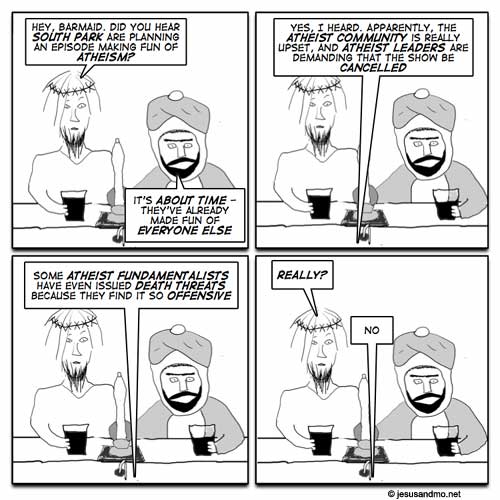
I don't know where I should put this, but I figured here was as good a place as any.
 |
|
| Back to top |
|
|
Tiberious aka Sparkles

Joined: 23 Jan 2003
Location: I'm one cool cat!
|
| Posted: Sun Nov 12, 2006 3:01 am Post subject: |
|
|
For you fine folks, the climactic conclusion to Go, God, Go!:
http://thelastboss.com/post.phtml?pk=1520
Science H. Logic, that may have been funnier than pt. I. |
|
| Back to top |
|
|
flotsam
Joined: 28 Mar 2006
|
| Posted: Sun Nov 12, 2006 7:01 am Post subject: |
|
|
Richard Tapdancing Dawkins, dude. |
|
| Back to top |
|
|
flotsam
Joined: 28 Mar 2006
|
| Posted: Mon Nov 13, 2006 7:29 pm Post subject: |
|
|
Been so busy this semester it's basically been impossible to do anything but read, write and post. But tonight I got to do some personal reading, and it reminded me to post some little tidbits for the punters out there who are still having some trouble with the whole Buddhist thing...
Food for thought:
| Quote: |
I THE CREED OF THE BUDDHA
The Buddha is generally associated with the doctrine of Ahimsa. That is taken to be the be-all and end-all of his teachings. Hardly any one knows that what the Buddha taught is something very vast: far beyond Ahimsa. It is therefore necessary to set out in detail his tenets. I enumerate them below as I have understood them from my reading of the Tripitaka :
1. Religion is necessary for a free Society.
2. Not every Religion is worth having.
3. Religion must relate to facts of life and not to theories and speculations about God, or Soul or Heaven or Earth.
4. It is wrong to make a God the centre of Religion.
5. It is wrong to make salvation of the soul as the centre of Religion.
6. It is wrong to make animal sacrifices to be the centre of religion.
7. Real Religion lives in the heart of man and not in the Shastras.
8. Man and morality must be the centre of religion. If not, Religion is a cruel superstition.
9. It is not enough for Morality to be the ideal of life. Since there is no God it must become the Law of Life.
10. The function of Religion is to reconstruct the world and to make it happy and not to explain its origin or its end.
11. That the unhappiness in the world is due to conflict of interest and the only way to solve it is to follow the Ashtanga Marga.
12. That private ownership of property brings power to one class and sorrow to another.
13. That it is necessary for the good of Society that this sorrow be removed by removing its cause.
14. All human beings are equal.
15. Worth and not birth is the measure of man.
16. What is important is high ideals and not noble birth.
17. Maitri or fellowship towards all must never be abandoned. One owes it even to one's enemy.
18. Every one has a right to learn. Learning is as necessary for man to live as food is.
19. Learning without character is dangerous.
20. Nothing is infallible. Nothing is binding forever. Every thing is subject to inquiry and examination.
21. Nothing is final.
22. Every thing is subject to the law of causation.
23. Nothing is permanent or sanatan. Every thing is subject to change. Being is always becoming.
24. War is wrong unless it is for truth and justice.
25. The victor has duties towards the vanquished.
This is the creed of the Buddha in a summary form. How ancient hut how fresh! How wide and how deep are his teachings!
B.R. Ambedkar |
| Quote: |
The World Buddhist Sangha Council was first convened by Theravadins in Sri Lanka in 1966 with the hope of bridging differences and working together. The first convention was attended by leading monks, from many countries and sects, Mahaayaana as well as Theravaada.
The following, written by Ven. Walpola Rahula was approved unanimously.
Basic Points Unifying The Theravaada and the Mahaayaana
1. The Buddha is our only Master.
2. We take refuge in the Buddha, the Dhamma and the Sangha.
3. We do not believe that this world is created and ruled by a God.
4. Following the example of the Buddha, who is the embodiment of Great Compassion (mahaa-karu.naa) and Great Wisdom (mahaa- praj~naa), we consider that the purpose of life is to develop compassion for all living beings without discrimination and to work for their good, happiness, and peace; and to develop wisdom leading to the realization of Ultimate Truth.
5. We accept the Four Noble Truths, nameley Dukkha, the Arising of Dukkha, the Cessation of Dukkha, and the Path leading to the Cessation of Dukkha; and the universal law of cause and effect as taught in the pratiitya-samutpaada (Conditioned Genesis or Dependent Origination).
6. We understand, according to the teaching of the Buddha, that all conditioned things (sa.mskaara) are impermanent (anitya) and dukkha, and that all conditioned and unconditioned things (dharma) are without self (anaatma).
7. We accept the Thirty-seven Qualities conducive to Enlightenment (bodhipak.sa-dharma) as different aspects of the Path taught by the Buddha leading to Enlightenment.
8. There are three ways of attaining bodhi or Enlightenment, according to the ability and capacity of each individual: namely as a disciple (sraavaka), as a Pratyeka-Buddha and as a Samyak-sam-Buddha (perfectly and Fully Enlightened Buddha). We accept it as the highest, noblest, and most heroic to follow the career of a Bodhisattva and to become a Samyak-sam-Buddha in order to save others.
9. We admit that in different countries there are differences with regard to the life of Buddhist monks, popular Buddhist beliefs and practices, rites and ceremonies, customs and habits. These external forms and expressions should not be confused with the essential teachings of the Buddha.
Source: Walpola Rahula; The Heritage of the Bhikkhu; (New York, Grove Press, 1974); pp. 100, 1137-138. |
| Quote: |
Expansion of the Formula
Ven. Walpola Sri Rahula in 1981 offered an alternative to the Nine-point formula above restating it as follows:
* Whatever our sects, denominations or systems, as Buddhists we all accept the Buddha as our Master who gave us the Teaching.
* We all take refuge in the Triple Jewel: the Buddha, our Teacher; the Dhamma, his teaching; and the Sangha, the Community of holy ones. In other words, we take refuge in the Teacher, the Teaching and the Taught.
* Whether Theravāda or Mahāyāna, we do not believe that this world is created and ruled by a god at his will.
* Following the example of the Buddha, our Teacher, who is embodiment of Great Compassion (mahākaruṇa) and Great Wisdom (mahāprajñā), we consider that the purpose of life is to develop compassion for all living beings without discrimination and to work for their good, happiness and peace; and to develop wisdom leading to the realization of Ultimate Truth.
* We accept the Four Noble Truths taught by the Buddha, namely, Dukkha, the fact that our existence in this world is in predicament, is impermanent, imperfect, unsatisfactory, full of conflict; Samudaya, the fact that this state of affairs is due to our egoistic selfishness based on the false idea of self; Nirodha, the fact that there is definitely the possibility of deliverance, liberation, freedom from this predicament by the total eradication of the egoistic selfishness; and Magga, the fact that this liberation can be achieved through the Middle Path which is eight-fold, leading to the perfection of ethical conduct (sila), mental discipline (samadhi) and wisdom (panna).
* We accept the universal law of cause and effect taught in the Paṭiccasamuppada (Skt. pratītyasamutpada; Conditioned Genesis or Dependent Origination), and accordingly we accept that everything is relative, interdependent and interrelated and nothing is absolute, permanent and everlasting in this universe.
* We understand, according to the teaching of the Buddha, that all conditioned things (samkhara) are impermanent (anicca) and imperfect and unsatisfactory (dukkha), and all conditioned and unconditioned things (dhamma) are without self (anatta).
* We accept the Thirty-seven Qualities conducive to Enlightenment (bodhipakkhiyadhamma) as different aspects of the Path taught by the Buddha leading to Enlightenment, namely:
** Four Forms of Presence of Mindfulness (Pali: satipatthana; Skt. smrtyupasthana);
** Four Right Efforts (Pali. sammappadhana; Skt. samyakpradhana);
** Four Bases of Supernatural Powers (Pali. iddhipada; Skt. rddhipada);
** Five Faculties (indriya: Pali. saddha, viriya, sati, samadhi, panna; Skt. sraddha, virya, smrti, samadhi, prajna);
** Five Powers (bala, same five qualities as above);
** Seven Factors of Enlightenment (Pali. bojjhanga; Skt. bobhyanga);
** Eight-fold Noble Path (Pali. ariyamagga; Skt. aryamarga).
* There are three ways of attaining Bodhi or Enlightenment according to the ability and capacity of each individual: namely, as a Sravaka (disciple), as a Pratyekabuddha (Individual Buddha) and as a Samyaksambuddha (Perfectly and Fully Enlightened Buddha). We accept if as the highest, noblest and most heroic to follow the career of a Boddhisattva and to become a Samyksambuddha in order to save others. But these three states are on the same Path, not on different paths. In fact, the Sandhinirmocana-sutra, a well-known important Mahayana sutra, clearly and emphatically says that those who follow the line of Sravaka-yana (Vehicle of Disciples) or the line of Pratyekabuddha-yana (Vehicle of Individual Buddhas) or the line of Tathagatas (Mahayana) attain the supreme Nirvana by the same Path, and that for all of them there is only one Path of Purification (visuddhi-marga) and only one Purification (visuddhi) and no second one, and that they are not different paths and different purifications, and that Sravakayana and Mahayana constitute One Vehicle One Yana (eka-yana) and not distinct and different vehicles or yanas.[6]
* We admit that in different countries there are differences with regard to the ways of life of Buddhist monks, popular Buddhist beliefs and practices, rites and rituals, ceremonies, customs and habits. These external forms and expressions should not be confused with the essential teachings of the Buddha.
|
| Quote: |
For Oo Maung the similarities between the Theravada and Mahayana are found in:
The Four Noble Truths, The Eightfold Path, The Paticca-samuppada (or the Dependent Origination), Anicca, Dukkha, Anatta, Sila, Samadhi, Panna and the rejection of the concept of a Supreme God. |
| Quote: |
The Buddha was silent on the question of God. What about you?
Why did the Buddha not say anything about God? Because he talked about the law of causality. Once you accept the law of cause and effect, the implication is that there is no 'creator'. If the Buddha accepted the concept of a creator, he would not have been silent; everything would have been God!
Who caused the law of causality?
About that, the Buddha would say 'the mind', never God or dharmakaya or even the Buddha himself.
How did the mind come about?
The source of mind is nature. The word that been used for existence is 'interdependent arising'. Talking of God, who created God? There is no point arguing. Dharmakeerti and Shantideva debate the existence of God and reach the conclusion that if we believe in a benevolent creator, how do we explain suffering? I remember a funny incident. In Tibetan drama, criticism is allowed and even the Buddha is not spared. There was this man acting on-stage and he was saying that he did not believe in God. If God made us, he said, instead of putting both the eyes in the front, one should be at the back! We would have been more efficient that way. Jokes apart, the idea is not to disrespect any religion but to analyze the nature of reality.
Interview with the Dalai Lama |
| Quote: |
Generally speaking I believe that all the major world religions have the potential to serve humanity and develop good human beings. By "good" or "nice", I don't mean that people look good, I mean they have a good and more compassionate heart. This is why I always say it is better to follow one's own traditional religion, because by changing religion you may eventually find emotional or intellectual difficulties. For example, here in England the traditional religious culture is Christian, so it may be better for you to follow that.
However, for those of you who really feel that your traditional religion is not effective for you, and for those who are radical atheists, then the Buddhist way of explaining things may hold some attraction...(p. 2)
Whether or not we like the philosophy of other religions isn't really the point. For a non-Buddhist, the idea of nirvana seems nonsensical. Similarly, to Buddhists the idea of a Creator God sounds like nonsense. But these things don't matter; we can drop them...(p. 5)
HHDL, The Four Noble Truths |
I can see how this can all lead to rampant confusion on the issue of Buddhists being atheists. Sorry these relatively unknown figures, these hacks, are so unclear. ^^ |
|
| Back to top |
|
|
Troll_Bait
Joined: 04 Jan 2006
Location: [T]eaching experience doesn't matter much. -Lee Young-chan (pictured)
|
| Posted: Tue Nov 14, 2006 5:48 am Post subject: |
|
|
| flotsam wrote: |
I THE CREED OF THE BUDDHA
The Buddha is generally associated with the doctrine of Ahimsa. That is taken to be the be-all and end-all of his teachings. Hardly any one knows that what the Buddha taught is something very vast: far beyond Ahimsa. It is therefore necessary to set out in detail his tenets. I enumerate them below as I have understood them from my reading of the Tripitaka :
1. Religion is necessary for a free Society.
2. Not every Religion is worth having.
3. Religion must relate to facts of life and not to theories and speculations about God, or Soul or Heaven or Earth.
4. It is wrong to make a God the centre of Religion.
5. It is wrong to make salvation of the soul as the centre of Religion.
6. It is wrong to make animal sacrifices to be the centre of religion.
7. Real Religion lives in the heart of man and not in the Shastras.
8. Man and morality must be the centre of religion. If not, Religion is a cruel superstition.
9. It is not enough for Morality to be the ideal of life. Since there is no God it must become the Law of Life.
10. The function of Religion is to reconstruct the world and to make it happy and not to explain its origin or its end.
11. That the unhappiness in the world is due to conflict of interest and the only way to solve it is to follow the Ashtanga Marga.
12. That private ownership of property brings power to one class and sorrow to another.
13. That it is necessary for the good of Society that this sorrow be removed by removing its cause.
14. All human beings are equal.
15. Worth and not birth is the measure of man.
16. What is important is high ideals and not noble birth.
17. Maitri or fellowship towards all must never be abandoned. One owes it even to one's enemy.
18. Every one has a right to learn. Learning is as necessary for man to live as food is.
19. Learning without character is dangerous.
20. Nothing is infallible. Nothing is binding forever. Every thing is subject to inquiry and examination.
21. Nothing is final.
22. Every thing is subject to the law of causation.
23. Nothing is permanent or sanatan. Every thing is subject to change. Being is always becoming.
24. War is wrong unless it is for truth and justice.
25. The victor has duties towards the vanquished.
This is the creed of the Buddha in a summary form. How ancient hut how fresh! How wide and how deep are his teachings!
B.R. Ambedkar |
Red:
Be skeptical, yet have an open mind. Yup. Got it.
Green:
YIKES!! Talk about leaving yourself an "out." Hasn't everyone who's ever gone to war claimed that they were doing it for truth and justice? When was the last time anyone said, "Hey, let's go to war for lies and injustice"?
| Quote: |
Expansion of the Formula
Ven. Walpola Sri Rahula in 1981 offered an alternative to the Nine-point formula above restating it as follows:
* Whatever our sects, denominations or systems, as Buddhists we all accept the Buddha as our Master who gave us the Teaching.
* We all take refuge in the Triple Jewel: the Buddha, our Teacher; the Dhamma, his teaching; and the Sangha, the Community of holy ones. In other words, we take refuge in the Teacher, the Teaching and the Taught.
* Whether Theravāda or Mahāyāna, we do not believe that this world is created and ruled by a god at his will.
* Following the example of the Buddha, our Teacher, who is embodiment of Great Compassion (mahākaruṇa) and Great Wisdom (mahāprajñā), we consider that the purpose of life is to develop compassion for all living beings without discrimination and to work for their good, happiness and peace; and to develop wisdom leading to the realization of Ultimate Truth.
* We accept the Four Noble Truths taught by the Buddha, namely, Dukkha, the fact that our existence in this world is in predicament, is impermanent, imperfect, unsatisfactory, full of conflict; Samudaya, the fact that this state of affairs is due to our egoistic selfishness based on the false idea of self; Nirodha, the fact that there is definitely the possibility of deliverance, liberation, freedom from this predicament by the total eradication of the egoistic selfishness; and Magga, the fact that this liberation can be achieved through the Middle Path which is eight-fold, leading to the perfection of ethical conduct (sila), mental discipline (samadhi) and wisdom (panna).
* We accept the universal law of cause and effect taught in the Paṭiccasamuppada (Skt. pratītyasamutpada; Conditioned Genesis or Dependent Origination), and accordingly we accept that everything is relative, interdependent and interrelated and nothing is absolute, permanent and everlasting in this universe.
* We understand, according to the teaching of the Buddha, that all conditioned things (samkhara) are impermanent (anicca) and imperfect and unsatisfactory (dukkha), and all conditioned and unconditioned things (dhamma) are without self (anatta).
* We accept the Thirty-seven Qualities conducive to Enlightenment (bodhipakkhiyadhamma) as different aspects of the Path taught by the Buddha leading to Enlightenment, namely:
** Four Forms of Presence of Mindfulness (Pali: satipatthana; Skt. smrtyupasthana);
** Four Right Efforts (Pali. sammappadhana; Skt. samyakpradhana);
** Four Bases of Supernatural Powers (Pali. iddhipada; Skt. rddhipada);
** Five Faculties (indriya: Pali. saddha, viriya, sati, samadhi, panna; Skt. sraddha, virya, smrti, samadhi, prajna);
** Five Powers (bala, same five qualities as above);
** Seven Factors of Enlightenment (Pali. bojjhanga; Skt. bobhyanga);
** Eight-fold Noble Path (Pali. ariyamagga; Skt. aryamarga).
* There are three ways of attaining Bodhi or Enlightenment according to the ability and capacity of each individual: namely, as a Sravaka (disciple), as a Pratyekabuddha (Individual Buddha) and as a Samyaksambuddha (Perfectly and Fully Enlightened Buddha). We accept if as the highest, noblest and most heroic to follow the career of a Boddhisattva and to become a Samyksambuddha in order to save others. But these three states are on the same Path, not on different paths. In fact, the Sandhinirmocana-sutra, a well-known important Mahayana sutra, clearly and emphatically says that those who follow the line of Sravaka-yana (Vehicle of Disciples) or the line of Pratyekabuddha-yana (Vehicle of Individual Buddhas) or the line of Tathagatas (Mahayana) attain the supreme Nirvana by the same Path, and that for all of them there is only one Path of Purification (visuddhi-marga) and only one Purification (visuddhi) and no second one, and that they are not different paths and different purifications, and that Sravakayana and Mahayana constitute One Vehicle One Yana (eka-yana) and not distinct and different vehicles or yanas.[6]
* We admit that in different countries there are differences with regard to the ways of life of Buddhist monks, popular Buddhist beliefs and practices, rites and rituals, ceremonies, customs and habits. These external forms and expressions should not be confused with the essential teachings of the Buddha. |
Cyan:
Wait a minute. How can a true atheist believe in supernatural powers? Maybe something's getting bent in translation.
- / - / - / - / - / - / - / - / - / - / - / - / -
I'm curious about which books and/or websites these are from. |
|
| Back to top |
|
|
flotsam
Joined: 28 Mar 2006
|
| Posted: Tue Nov 14, 2006 10:52 am Post subject: |
|
|
Dood.
Your red argument doesn't mean that the Buddha was a clam, does it?
Skepticism doesn't mean everything is true. When you start doubting a clam is a clam and start thinking it's a hippo, and then you decide it's a hippo and you finally convince yourself 100% it is indeed a hippo, you still won't find any tusks, and it still doesn't make sense to make hippo chowder. If you want a hippo, go get a hippo. Common sense mate.
Also, supernatural doesn't have to mean gods and such--it just means beyond the common perception of natural--like being an enlightened Boddhisatva. Shame on you.
As for the green, yeah, not sure where I stand with that yet. Certainly a loophole in the wrong hands, but even for those who strive for ahimsa it's the old "Do I kill to protect my child?" debate. That's karma.
I will try to find the websites for the Theravada/Mahayana stuff again. The Ambedkar I took from a book titled Modern Buddhism, don't have the editor info with me right now. And the HHDL stuff is from the book of the book referenced by moi. |
|
| Back to top |
|
|
gang ah jee
Joined: 14 Jan 2003
Location: city of paper
|
| Posted: Tue Nov 14, 2006 11:55 am Post subject: |
|
|
It was extremely funny, science be praised. "I shall eat his entrails ... on my tummy!" I actually just saw Dawkins' reaction to the show (here at about 1:50. Pretty smooth. |
|
| Back to top |
|
|
flotsam
Joined: 28 Mar 2006
|
| Posted: Tue Nov 14, 2006 2:56 pm Post subject: |
|
|
| gang ah jee wrote: |
It was extremely funny, science be praised. "I shall eat his entrails ... on my tummy!" I actually just saw Dawkins' reaction to the show (here at about 1:50. Pretty smooth. |
The boy. |
|
| Back to top |
|
|
tomato

Joined: 31 Jan 2003
Location: I get so little foreign language experience, I must be in Koreatown, Los Angeles.
|
|
| Back to top |
|
|
|
|
You cannot post new topics in this forum
You cannot reply to topics in this forum
You cannot edit your posts in this forum
You cannot delete your posts in this forum
You cannot vote in polls in this forum
|
|


 FAQ
FAQ Search
 Memberlist
 Usergroups
 Register
 Profile
 Log in to check your private messages
 Log in


