

|
Korean Job Discussion Forums
"The Internet's Meeting Place for ESL/EFL Teachers from Around the World!"
|
| View previous topic :: View next topic |
| Author |
Message |
gdimension

Joined: 05 Jul 2005
Location: Jeju
|
 Posted: Mon Dec 11, 2006 4:25 am Post subject: Posted: Mon Dec 11, 2006 4:25 am Post subject: |
 |
|
I'm still undecided about this plan. My gut reaction was, "Great!", but the more I think about it, the more I'm not so sure money wouldn't be better spent on other space projects.
Here is the opening and closing of an interesting article on Slate:
| Quote: |
The United States will have a permanent base on the moon by the year 2024, NASA officials said on Monday. What does the space agency hope to discover on the moon? The reason it built the base.
...
What should NASA do? As I argued in Slate back in March, rational budget priorities for the agency would include first and foremost an exhaustive study of the sun, as well as the Earth and Mars and Venus, the two other Earthlike planets in the solar system, with automated probes and satellites. Second, it borders on criminal that NASA is doing nothing to prepare for a deadly comet or asteroid strike. (The agency says it has already cataloged 835 "potentially hazardous" large space rocks.) Third, space telescopes should continue to be used to study the distant universe. Fourth, researchers should be working on a breakthrough in propulsion technology, which could make getting to the moon more affordable. |
Read the rest here. |
|
| Back to top |
|
 |
mithridates

Joined: 03 Mar 2003
Location: President's office, Korean Space Agency
|
| Posted: Mon Dec 11, 2006 8:26 am Post subject: |
|
|
I like the way that guy thinks. I'm also of the opinion that we should be spending a huge amount of resources on finding out about things that matter to the average person, especially the discovery of Earth-like planets in other solar systems.
This is another good quote by him in March:
| Quote: |
What would constitute rational budget priorities for NASA? The agency's first emphasis should be research about Earth and the sun. That's the sole area in which NASA spending is odds-on to produce immediate returns for taxpayers. Second, NASA should fund more automated probes and satellites to study this solar system and close-by star systems�the parts of space that might have some effect on us. Almost all NASA findings since the moon program have come from automated probes such as Cassini, which a few weeks ago discovered what appears to be a water vent on a moon of Saturn. Most probe projects cost less than a single launch of the space shuttle. Third, the agency should cancel the shuttle program and use the funds to research new propulsion systems that might fundamentally reduce the price of access to space. A fundamental propulsion breakthrough must come before grand visions like a Mars mission. Currently NASA is working on a new launcher to replace the shuttle, but that system will be cobbled together from existing engines and hardware and won't notably differ from rockets of the 1960s.
Fourth, NASA needs a serious program for searching nearby space for asteroids and comets that might strike Earth and figuring out how to deflect any big rock headed this way. Asteroids and comets large enough to cause devastation may strike Earth distressingly often; for instance, it is believed thousands of people were killed by a smallish space rock that hit China in 1490. (Here is more on the chance of a calamitous comet or asteroid impact.) Even if asteroid and comet strikes only happen in intervals of thousands of years, that doesn't change the chances that a space rock is headed our way right now, in the same sense that a coin coming up heads 10 times in a row has no bearing on what the next flip will produce. If NASA protected Earth against a strike from space, that might be, let's say, the most significant accomplishment in human history. Yet NASA has only a minor program to search for "near-Earth objects" and no program to figure out what to do about them. Preventing comet strikes would give taxpayers a return on their money, and we can't have that! The new budget request suggests that no one in the agency's hidebound, turf-obsessed upper management wants to think about what NASA can do to actually benefit the public. |
This next article is one of the most exciting articles I read this year, about the possibility of life around red dwarf stars, the most common stars in the universe. If they can support life, then the chance of finding it goes up at least tenfold.
http://www.kencroswell.com/reddwarflife.html |
|
| Back to top |
|
|
Zoidberg

Joined: 29 Mar 2006
Location: Somewhere too hot for my delicate marine constitution
|
| Posted: Mon Dec 11, 2006 3:47 pm Post subject: |
|
|
I like the final part, about how alien astronomers might think about a world like ours.
| Quote: |
Which leads to an intriguing thought. Any planets that circle red dwarfs may have given rise to astronomers as parochial as those on Earth. These alien observers may have concluded that only red dwarfs can support life, blessed as they are with stable planets where suns never set and seasons never disrupt the climate. Indeed, their SETI programs may ignore Sun-like stars altogether. After all, they might argue, any temperate planet orbiting such a star would lie so far out that it would rotate freely, subjecting life to a relentless cycle of light and dark. Any tilt of the axis would cause severe summers and winters, and changes in axial tilt might induce ice ages, with mighty glaciers smothering much of the globe. How on Earth could life possibly arise on such a hostile world?
|
Great article.
Actually, great site. Lots of interesting articles. |
|
| Back to top |
|
|
mithridates
Joined: 03 Mar 2003
Location: President's office, Korean Space Agency
|
| Posted: Mon Dec 11, 2006 6:22 pm Post subject: |
|
|
| Zoidberg wrote: |
I like the final part, about how alien astronomers might think about a world like ours.
| Quote: |
Which leads to an intriguing thought. Any planets that circle red dwarfs may have given rise to astronomers as parochial as those on Earth. These alien observers may have concluded that only red dwarfs can support life, blessed as they are with stable planets where suns never set and seasons never disrupt the climate. Indeed, their SETI programs may ignore Sun-like stars altogether. After all, they might argue, any temperate planet orbiting such a star would lie so far out that it would rotate freely, subjecting life to a relentless cycle of light and dark. Any tilt of the axis would cause severe summers and winters, and changes in axial tilt might induce ice ages, with mighty glaciers smothering much of the globe. How on Earth could life possibly arise on such a hostile world?
|
Great article.
Actually, great site. Lots of interesting articles. |
That was my favourite part of the article too. The other advantage red dwarves have is their longevity - tens of billions of years and above in pretty much the same state gives a planet an extremely long time in which to develop complex life. The Wikipedia article on planetary habitability is quite good, and has been featured in both English and Spanish:
http://en.wikipedia.org/wiki/Planetary_habitability
The other interesting thing is that the closest star system to Earth is composed of a binary star system of two stars very similar to the Sun, one a bit bigger and the other a bit smaller, with a definite possibility for some terrestrial planets in their habitability zones, with a red dwarf star some distance away but still in the system that is actually the closest to the solar system (hence the name):
http://en.wikipedia.org/wiki/Proxima_Centauri |
|
| Back to top |
|
|
Troll_Bait

Joined: 04 Jan 2006
Location: [T]eaching experience doesn't matter much. -Lee Young-chan (pictured)
|
| Posted: Wed Dec 13, 2006 9:00 am Post subject: |
|
|
| mithridates wrote: |
| mnhnhyouh wrote: |
| Troll_Bait wrote: |
If we could redistribute some of Earth's population onto other heavenly bodies, then that would mean less population on Earth, which would put less stress on Earth's ecosystem. Surely that would help decrease poverty, wouldn't it? |
In 1940 there were about 1.5 billion on earth, in 1970, about 3 billion and in 2000 about 6 billion. This means we are doubling every 30 years.
In 350 years we get about 1 m squared each (that is 9 square feet or 3 feet by 3 feet for the metrically challenged).
in the 1960's Asimov used an estimation of the mass of the universe and the doubling rate to estimate it would take 3500 years to have so many people that the entire mass of the universe would have to be converted to people to sustain it.
While these scenarios are obviously impossible, they do indicate that heading to space will not solve problems generated by population growth. Only slowing population growth will do so.
However, I think the moon base a very good idea. We need to leave the cradle..... I also think we should stop wasting money on crap. <insert your own definition of crap here>.
h |
Apparently the world population should eventually peak at about 12 billion and then stay there. I don't remember where I read that.
The best way to slow down population growth is to have a good economy and plenty of opportunities so that people are more inclined to wait a few more years before they get married and settle down. It's okay because even if the population of a country slows, per capita effectiveness goes up. |
Not too long ago I read this book:
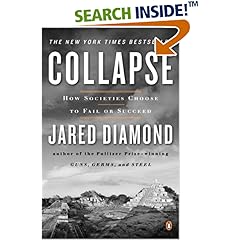
Collapse: How Societies Choose to Fail or Succeed, by Jared Diamond
| Page 494 & 495 wrote: |
| What really counts is not the number of people alone, but their impact on the environment. [...] On the average, each citizen of the U.S., western Europe, and Japan consumes 32 times more resources such as fossil fuels, and puts out 32 times more wastes, than do inhabitants of the Third World. [...] But low-impact people are becoming high-impact people ... [T]he biggest problem is the increase in total human impact, as the result of rising Third World living standards, and of Third World individuals moving to the First World and adopting First World living standards. There are many "optimists" who argue that the world could support double its human population, and who consider only the increase in human numbers and not the average increase in per-capita impact. But I have not met anyone who seriously argues that the world could support 12 times its current impact, althugh an increase of that factor would result from all Third World inhabitants adopting First World living standards. (That factor of 12 is less than the factor of 32 that I mentioned in the preceding paragraph, because there are already First World inhabitants with high-impact lifestyles, although they are greatly outnumbered by Third World inhabitants.) Even if the people of China alone achieved a First World living standard while everyone else's living standard remained constant, that would double our human impact on the world. |
|
|
| Back to top |
|
|
Kuros
Joined: 27 Apr 2004
|
| Posted: Wed Dec 13, 2006 9:23 am Post subject: |
|
|
| Troll_Bait wrote: |
Not too long ago I read this book:
[url=http://www.amazon.com/Collapse-Societies-Choose-Fail-Succeed/dp/0143036556/sr=1-1/qid=1166027769/ref=pd_bbs_sr_1/102-9251678-9342531?ie=UTF8&s=books]
Collapse: How Societies Choose to Fail or Succeed, by Jared Diamond[/url]
| Page 494 & 495 wrote: |
| What really counts is not the number of people alone, but their impact on the environment. [...] On the average, each citizen of the U.S., western Europe, and Japan consumes 32 times more resources such as fossil fuels, and puts out 32 times more wastes, than do inhabitants of the Third World. [...] But low-impact people are becoming high-impact people ... [T]he biggest problem is the increase in total human impact, as the result of rising Third World living standards, and of Third World individuals moving to the First World and adopting First World living standards. There are many "optimists" who argue that the world could support double its human population, and who consider only the increase in human numbers and not the average increase in per-capita impact. But I have not met anyone who seriously argues that the world could support 12 times its current impact, althugh an increase of that factor would result from all Third World inhabitants adopting First World living standards. (That factor of 12 is less than the factor of 32 that I mentioned in the preceding paragraph, because there are already First World inhabitants with high-impact lifestyles, although they are greatly outnumbered by Third World inhabitants.) Even if the people of China alone achieved a First World living standard while everyone else's living standard remained constant, that would double our human impact on the world. |
|
Jared Diamond's thesis is bizarre.
Human societies often collapse because they don't have enough children. They don't collapse because of the stress they press onto the environment. Unless Diamond wants to reference how carbon emmissions destroyed the people of Easter Island... |
|
| Back to top |
|
|
Troll_Bait
Joined: 04 Jan 2006
Location: [T]eaching experience doesn't matter much. -Lee Young-chan (pictured)
|
| Posted: Sat Dec 16, 2006 12:19 am Post subject: |
|
|
| Kuros wrote: |
| Troll_Bait wrote: |
Not too long ago I read this book:
[url=http://www.amazon.com/Collapse-Societies-Choose-Fail-Succeed/dp/0143036556/sr=1-1/qid=1166027769/ref=pd_bbs_sr_1/102-9251678-9342531?ie=UTF8&s=books]
Collapse: How Societies Choose to Fail or Succeed, by Jared Diamond[/url]
| Page 494 & 495 wrote: |
| What really counts is not the number of people alone, but their impact on the environment. [...] On the average, each citizen of the U.S., western Europe, and Japan consumes 32 times more resources such as fossil fuels, and puts out 32 times more wastes, than do inhabitants of the Third World. [...] But low-impact people are becoming high-impact people ... [T]he biggest problem is the increase in total human impact, as the result of rising Third World living standards, and of Third World individuals moving to the First World and adopting First World living standards. There are many "optimists" who argue that the world could support double its human population, and who consider only the increase in human numbers and not the average increase in per-capita impact. But I have not met anyone who seriously argues that the world could support 12 times its current impact, althugh an increase of that factor would result from all Third World inhabitants adopting First World living standards. (That factor of 12 is less than the factor of 32 that I mentioned in the preceding paragraph, because there are already First World inhabitants with high-impact lifestyles, although they are greatly outnumbered by Third World inhabitants.) Even if the people of China alone achieved a First World living standard while everyone else's living standard remained constant, that would double our human impact on the world. |
|
Jared Diamond's thesis is bizarre.
Human societies often collapse because they don't have enough children. They don't collapse because of the stress they press onto the environment. Unless Diamond wants to reference how carbon emmissions destroyed the people of Easter Island... |
Red:
It's not a thesis. It's a short excerpt from a rather large book.
Green:
I'm sorry, but I have to say that this is utter rubbish.
Violet:
How would you know?
Here's a crazy idea: How about reading a book before criticizing it?
Orange:
This should go into the dictionary under the definition of "Straw Man Argument."
Diamond goes over the collapse of several societies, including that of Easter Island, in detail. And yes, of course it had nothing to do with carbon emissions. Easter Island is an interesting case study because, since it was an island, the people there had nowhere to turn to. In other places, if society collapses, people can flee to neighboring areas. However, with the globalization of the world, the entire Earth has potentially become one big Easter Island. |
|
| Back to top |
|
|
ThePoet
Joined: 15 May 2004
Location: No longer in Korea - just lurking here
|
|
| Back to top |
|
|
|
|
You cannot post new topics in this forum
You cannot reply to topics in this forum
You cannot edit your posts in this forum
You cannot delete your posts in this forum
You cannot vote in polls in this forum
|
|


 FAQ
FAQ Search
 Memberlist
 Usergroups
 Register
 Profile
 Log in to check your private messages
 Log in


